
Custom Stainless Steel Jewelry: 100+ Piece Minimums
The 100+ figure on a stainless steel order is a floor per design, not a cap on the order and not a target. One design in four PVD colours therefore commits 4 × 100 = 400 pieces, while a three-design silver capsule at 50 pieces each commits 150. Reading the minimum correctly is the difference between a test run and an accidental full production run.
Key takeaways
- The published floors are 50 pieces for 925 sterling silver, 100 for brass and 100+ for stainless steel, all per design.
- One stainless design in four colours is 400 pieces, not 100.
- Mass production takes 21–28 days, or three to four weeks, once tooling exists.
- Final QC inspects 100% of pieces, so a 400-piece run means 400 checks.
What the plus sign in 100+ means
The stainless MOQ is published as 100+ pieces per design, and the floor is written with a plus rather than a fixed 100. The plus is not decoration. It signals that the minimum is a starting band rather than a fixed number, and that the exact figure for a design depends on the shape, the coating and the palette.
What does not move is the unit of measurement. The floor applies per design, so a buyer opening five designs at the minimum commits five times the minimum before counting colour variants. That is the single most common planning error in a first stainless order.
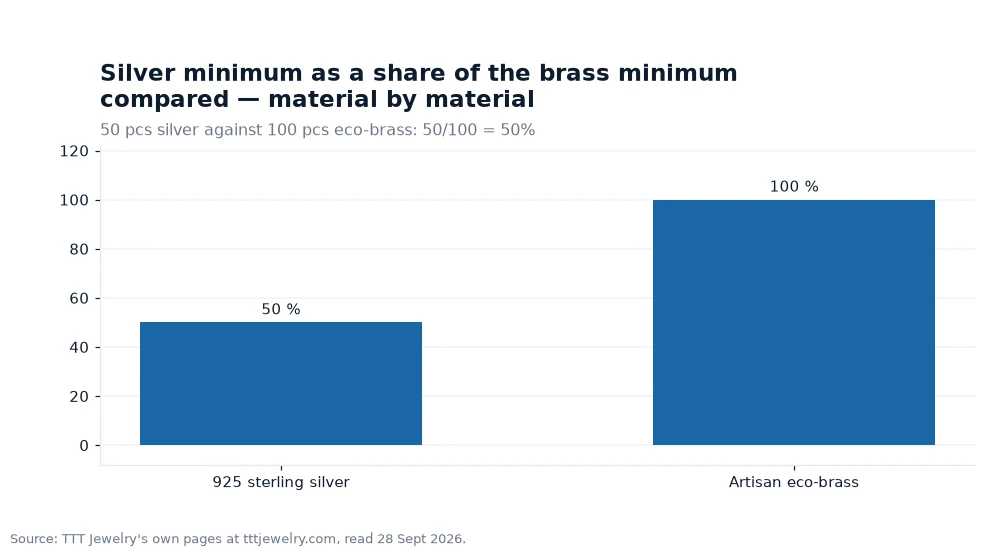
The floor also sits above silver. Silver starts at 50 pieces per design, brass at 100, and stainless at 100+. A brand that has only ordered silver will find its usual quantity buys half as many stainless designs, or the same number at twice the unit commitment.
None of this is a reason to inflate an order. It is a reason to plan the design count and the palette before asking for a quotation, because both multiply the commitment in a way the unit price does not show.
Three material floors, three planning logics
Each published floor supports a different kind of first order. Silver at 50 is the test-bed: small enough to try a shape and a finish without a large inventory. Brass at 100 is the volume line, where the lower metal cost and the artisan eco-brass position suit a broader range. Stainless at 100+ is the durability line, where the piece is expected to survive water, wear and daily use.
A mixed order does not blend the floors into one number. Each line is quoted against its own minimum, so a capsule of two silver designs, one brass design and one stainless design commits 2 × 50 + 1 × 100 + 1 × 100 = 300 pieces at the floors, before any colour variant.
The finishing route differs by material as well. Silver and brass are polished and electroplated, with an anti-tarnish e-coating available on both. Stainless is finished by PVD vacuum coating, which is why a colour decision on stainless multiplies the batch rather than adding a variant to an existing run.
| Order shape | Arithmetic | Pieces committed |
|---|---|---|
| One stainless design, one colour | 1 × 100 | 100+ |
| One stainless design, four colours | 4 × 100 | 400+ |
| Four stainless designs, one colour | 4 × 100 | 400+ |
| Three silver designs, one finish each | 3 × 50 | 150 |
| Two brass designs, one finish each | 2 × 100 | 200 |
Read the second and third rows together. Four designs in one colour and one design in four colours carry the same piece count, but they are not the same order. The first spreads tooling across four shapes; the second spreads it across one shape and four chamber runs.
Why a coating palette multiplies the floor
A PVD colour is a chamber run, not a dye lot. The part is loaded, the chamber is pumped down, the source material is vaporised and the film is deposited. Changing colour means changing the source and cleaning the chamber, so each colour behaves like a separate small production batch.
That is why the floor is best read per design per colour. A buyer who approves a design in gold tone and then adds a second colour three weeks later is not adding units to an open batch; the buyer is opening a second batch and paying the setup again.
For a PVD stainless steel jewelry wholesale programme, the palette is therefore a planning decision rather than a late addition. Two colours chosen at the CAD stage share one sample review; two colours chosen a month apart share nothing.
The practical answer is to decide the palette at the CAD stage. If the range needs two colours, plan both in the first run and approve them on the same sample review. If only one colour is funded, keep the second as a documented reorder rather than a late addition.
Design and colour are separate multipliers, and both are visible before a quote. That is the useful part of the arithmetic: none of it requires a price list, only the published floors and a design count.
What the floor is actually paying for
A minimum order exists because fixed work does not shrink with the batch. Tooling is cut once. A sample is made once. Racks and fixtures are set once. A chamber cycle uses the same pump-down whether it holds 100 pieces or 300.
Splitting a small order across many designs repeats that fixed work many times. A buyer with 400 pieces to spend can put them into four designs at 100 each, or one design at 400. The second option spreads the fixed cost over four times as many units, and it also produces a deeper stock position in a single proven shape.
That is a commercial judgment, not a rule. A brand testing a market may prefer four designs at the minimum, because the information from four shapes is worth more than a lower unit cost on one. A brand reordering a proven shape should push quantity into that shape instead.
Tooling reuse is the lever on the second order. Once a mould exists, the fixed charge stops repeating, and the reorder is priced on conversion rather than development. The published production window for that stage is 21–28 days.
Worked example
A brand plans three stainless designs in two colours each. The commitment is 3 × 2 × 100 = 600 pieces. If the same brand drops to one colour per design, the order falls to 3 × 100 = 300 pieces, a difference of 300 units and three chamber runs.
Compare a silver capsule of the same design count: 3 × 50 = 150 pieces. The stainless version is 300 pieces at one colour, so the material change doubles the piece commitment before any colour decision. The silver floor is exactly 50% of the stainless floor.
Now spread a fixed tooling charge T over a reorder. At 100 pieces the share is T/100; at 300 pieces of the same design it is T/300, one third. The mould cost has not changed, only the number of units carrying it.
The calendar is short once tooling exists. Production at 21–28 days is 3–4 weeks, and final QC inspects 100% of the run. A 300-piece order therefore produces 300 inspected pieces, not a 30-piece sample.
Frequently asked questions
Is the 100+ minimum per design or per order?
It is per design. Four stainless designs at the floor commit 400+ pieces before colour variants, and each additional PVD colour adds another run at the same floor.
Can a first order mix silver, brass and stainless steel?
Yes, but each line is planned against its own floor: 50 pieces per silver design, 100 per brass design and 100+ per stainless design.
Does a reorder need a new sample?
No, if the design and finish are unchanged and the tooling exists, so the reorder moves into production at the published 21–28 day window with 100% inspection.
Building the first order around the floor
Start with the number of designs the market can absorb, not the number of pieces the budget allows. Then apply the floor per design, add the palette, and check whether the total still makes sense as inventory.
A PVD stainless range bought at the floor in one colour is usually the cleanest first step, because it tests the shape and the finish without committing to a second chamber run. The factory direct manufacturing route keeps the tooling, coating and inspection in one line, which shortens the gap between sample and bulk.
When the shape proves itself, the reorder is where the arithmetic improves. The custom jewelry wholesale structure reuses existing moulds and CAD, so the second run carries conversion cost rather than development cost.
Treat the minimum as a planning input. It tells a brand how many designs it can afford to test, and it says nothing about how many pieces the market will take.
Source note: figures come from the manufacturer's own website (tttjewelry.com), read 28 Sept 2026.[1]