
OEM or ODM: Cost Breakdown for an Influencer Fragrance Line
The difference between OEM and ODM is usually described as a difference in ownership. In a budget, it shows up as a difference in which lines exist at all. Under ODM, development and formulation are part of the package and the first order is cheaper to start. Under OEM, the brand pays for development, and in exchange it can carry a scent and a specification that are its own. Neither is cheaper in general; they are cheaper at different points in the life of a brand.
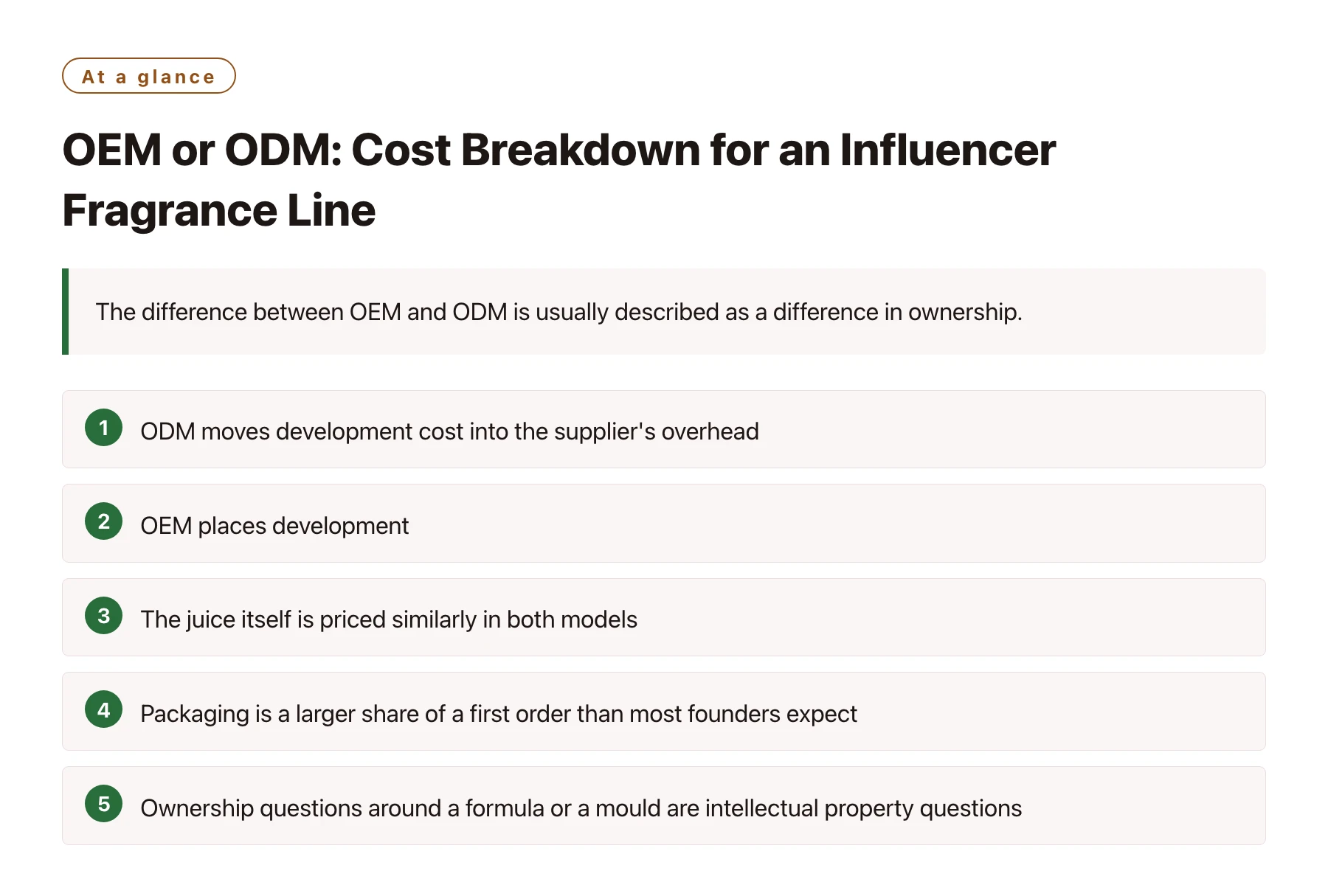
Key takeawaysODM moves development cost into the supplier's overhead, which lowers the entry cost but usually narrows what the brand can claim as its own. · OEM places development, formula control and exclusivity on the brand's side of the ledger, so the first order carries more cost and later orders carry more advantage. · The juice itself is priced similarly in both models; the divergence appears in development, tooling, ownership and the minimum quantities attached to each. · Packaging is a larger share of a first order than most founders expect, and packaging rules in the destination market increasingly affect weight, material and recyclability choices [1]. · Ownership questions around a formula or a mould are intellectual property questions, and the World Intellectual Property Organization publishes general guidance on protecting such assets [2].
An influencer brand usually approaches its first order with a budget and a launch window, and asks which model fits. The honest answer depends on how long the brand intends to sell the product, because the two models distribute cost differently over time rather than changing the total.
This breakdown lists the cost lines in a first fragrance order and shows how each behaves under OEM and under ODM. It is written for a founder building the first budget, not for a procurement team optimising an established range.
Cost lines under each model
| Cost line | Under ODM | Under OEM |
|---|---|---|
| Scent development | Included, using directions the supplier already holds | Charged, and quoted by round or as a development fee |
| Formula ownership | Usually retained by the supplier, with use rights agreed in the terms | Negotiable, and normally intended to sit with the brand |
| Exclusivity | Rarely granted, because the formula serves other clients | Commonly available, and priced or tied to volume commitments |
| Juice | Priced on dosage and material cost | Priced the same way, with the same drivers |
| Components and tooling | Standard components, which keeps setup low | Custom components possible, with tooling cost and a longer timeline |
| Testing and documents | Standard set for the format and the market | Same set, plus any testing specific to the brand's own specification |
| Minimum order | Often lower, because the direction already exists | Often higher, because development has to be recovered |
Reading the table by column is more useful than reading it by row. The ODM column concentrates cost in the order; the OEM column concentrates cost in the setup, and setup is where the brand builds an asset.
Why the first order is not the whole comparison
A first-order comparison almost always favours ODM, because development is invisible in the unit price. The picture changes on the second and third order, when the brand is paying for the same direction again without accumulating anything.
The question to ask is how long the scent is expected to sell. A product tied to a single moment, a collaboration or a seasonal drop may never justify the development cost of an exclusive formula. A signature scent intended to run for years usually does, because the development fee is spread across many orders and the brand owns the result.
There is a middle route as well. A brand can start on a supplier direction and commission development later, once the audience has responded. That sequencing keeps the first order small while preserving the option to move to an owned formula. What it does not preserve is the exclusivity of the first scent, which may already be in use elsewhere.
Cost discussions also tend to underestimate how much of the total sits in the pack. Decoration, component weight and presentation drive both the manufacturing cost and the freight cost, and they are chosen early enough that changing them later invalidates work. Reviewing the cost drivers in custom fragrance wholesale before the design is fixed is considerably cheaper than rediscovering them after tooling has been ordered.
Where packaging cost hides in a first order
Three items are frequently left out of a founder's first budget: the setup charges attached to decoration, the cost of the components that fail inspection, and the freight impact of a heavier pack. None of them appear on a simple unit price, and all three are decided by design choices made at the briefing stage.
Packaging regulation is a further consideration, because rules on packaging weight, material and recyclability are tightening in several markets and affect design decisions that used to be purely aesthetic [1]. A pack chosen without that in mind can be expensive to redesign later.
The costs that appear after the first order
A reorder is cheaper than a first order in both models, but the reason differs. Under ODM, the saving comes from repeating a known production run. Under OEM, the saving comes from repeating a known production run and from not paying development a second time.
The second-order costs that surprise founders are usually administrative. Artwork revisions, label updates for a new market, additional testing for a new channel, and the freight and duty on a larger shipment. These are not manufacturing costs, but they belong in the budget because they arrive with the growth of the brand.
A third category is the cost of change. Moving from an ODM direction to an owned formula later means paying development once, and possibly reformulating to avoid the earlier direction. Moving the other way, from an owned formula to a supplier direction, gives up the asset. Both moves are legitimate; both should be anticipated rather than discovered.
This is why an assessment of OEM and ODM fragrance manufacturing is better made against a two-year plan than against a first invoice. The model that wins on order one is rarely the model that wins on order five.
A four-step way to build the budget
- Step 1: Cost the pack before the juiceComponents, decoration and cartons usually decide whether the product can hit its price point. Fixing them early prevents a reformulation to pay for packaging.
- Step 2: Ask for both models priced on the same briefA single brief quoted under OEM and under ODM shows where the two diverge, which is almost always in development, exclusivity and minimum quantities rather than in the liquid.
- Step 3: Add the post-order costsInclude artwork updates, market-specific testing, freight, duty and spare units. A budget that ends at the factory gate is not the cost of the launch.
- Step 4: Decide what the brand must ownIf exclusivity is part of the promise to the audience, it has to be purchased. If it is not part of the promise, the same money may be better spent on the pack and on the first marketing push.
Reading a quote from either model
Quotes differ in structure more than in total, and the structure is what makes comparison possible. Ask for development, juice, components, decoration, testing and freight as separate lines, with the assumptions behind each one written next to it.
The most revealing question is what a quote excludes. A low unit price frequently excludes decoration setup, artwork work, market-specific testing or spare units. Knowing the exclusions in advance turns a comparison from a guess into a decision.
It is also worth understanding who owns what when the relationship ends. Under either model, the formula, the tooling and the test data have different owners, and protecting those assets is a documented exercise rather than a verbal understanding, which is why general guidance on intellectual property protection is relevant even to a small brand [2].
A brand comparing a factory that describes itself as a contract manufacturer for perfume brands with one that offers a fuller development service is really comparing degrees of ownership. Reviewing where a quote can hide cost, in the way described for where a perfume quote can hide costs, is a reasonable final check before a budget is approved.
For context on how quickly the category moves, trade coverage of launches and retail activity is a useful reality check on a first-year plan [3]. It is not a forecast, but it is a reminder that a fragrance line is usually a multi-year project rather than a single drop.
Decide the model by asking what the brand must own in two years, not what the first order costs. If exclusivity is part of the promise, budget development in the first order rather than paying to rebuild it later.
Sources
- European Commission: Packaging Waste and the PPWR —— EU rules on packaging and packaging waste, including the Packaging and Packaging Waste Regulation requirements on recyclability and design.
- WIPO — World Intellectual Property Organization —— The UN agency for intellectual property; resources on industrial design and patent protection relevant to product and packaging design.
- Cosmetics Business —— A trade publication covering the beauty and cosmetics industry, including fragrance launches and regulatory developments.
Frequently asked questions
Is ODM always cheaper than OEM for a first order?
Usually, because development is included rather than charged, and minimum quantities are often lower since the direction already exists. The advantage narrows on later orders, when the brand repeats the same direction without accumulating an asset.
What does an ODM contract typically exclude?
Exclusivity is the most common exclusion, along with formula ownership. Decoration setup, market-specific testing and artwork work may also sit outside the unit price, so the exclusions matter as much as the headline number.
How much of a first fragrance budget goes to packaging?
Frequently a substantial share, especially where a distinctive pack is part of the launch. Components, decoration, cartons and the freight impact of weight all belong in the same budget line, and they are decided early.
Can a brand switch from ODM to its own formula later?
Yes, but it means paying for development at that point and accepting that the original direction may continue to be used by others. The sequencing is legitimate, provided the brand knows what it is giving up in the meantime.
What should be agreed about ownership before paying a development fee?
Who owns the formula, whether exclusivity applies and for how long, who owns any custom tooling, and what happens to the work if the relationship ends. Putting those four points in writing at the start avoids a much more expensive conversation later.